


1. The lifetime of a mechanical lifter is normally distributed with a mean of 100 hours and a standard deviation of 3 hours. What is the reliability of the lifter at 106 hours ?
A. 0.0228 B. 0.0570 C. 0.9430 D, 0.9772
2. A full factorial design of experiments has four factors. The first factor has two levels, the second factor has three levels, the third factor has two levels, and the final factor has four levels. How many runs are required for this analysis ?
A. 16 B. 48 C. 192 D. 256
3. On the basis of the fault tree, what is the likelihood of the top event occurring?
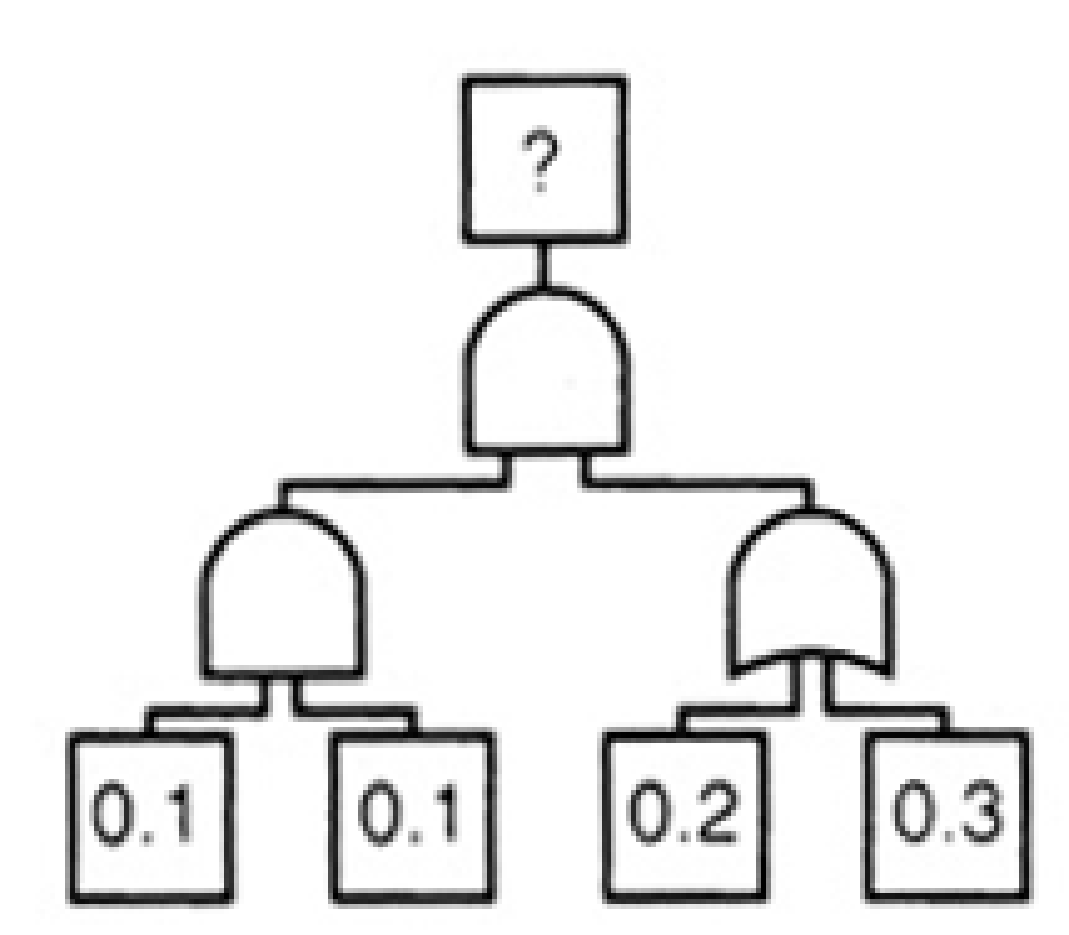
A. 0.0050 B. 0.2600 C. 0.3000 D. 0.5200
4. Assuming perfect switching and perfect starting, which of the following systems has the longest mean life if each system consists of n units with identical reliability ?
A. A series system. B. A parallel system.
C. A k out of n system. D. A cold standby system.
5. Which of the following is an appropriate use for experimental design ?
A. Establishing product requirements.
B. Developing a fault-tree analysis.
C. Ensuring the robust design of a product.
D. Analyzing customer complaint reports.
6. The primary aim of sequential-life testing is to determine:
A. The probability density function of failures.
B. The mean time between failures (MTBF).
C. Whether a lot meets the reliability goal.
D. Whether the stress-level variation is significant
7. A small sample from a product population is subjected to multiple levels of elevated stress. Which of the following could be used to model the life of the product ?
A. Poisson process. B. Pascal expansion.
C. Pareto rule. D. Inverse power law.
8. A component fails on the average of once every 4 years with 75% of the failures observed to occur during stormy weather. If there are 12 hours of stormy weather to every 240 hours of good weather, what are the failure rates for stormy and good weather, respectively ?
A. λ(Stormy) = 3.939 failure/yr, λ(Good) = 0.0656 failure/yr.
B. λ(Stormy) = 4.202 failure/yr, λ(Good) = 0.0525 failure/yr.
C. λ(Stormy) = 6.594 failure/yr, λ(Good) = 0.0458 failure/yr.
D. λ(Stormy) = 20.16 failure/yr, λ(Good) = 0.0403 failure/yr.
9. Given a reliability growth test in progress having accumulated 4 failures during 5000 test hours. Assume a growth rate of 0.3, what is the expected MTBF at 25,000 hours ?
A. 1250 hrs B. 1895 hrs C. 2026 hrs D. 3856 hrs
10. In a certain application, two identical transducers are used to measure the vacuum in a system. The system is considered to have failed if either of the vacuums read by the transducers varies from the standard by more than 10mm Hg. Which of the following is the correct reliability logic block diagram for the transducer assembly ?
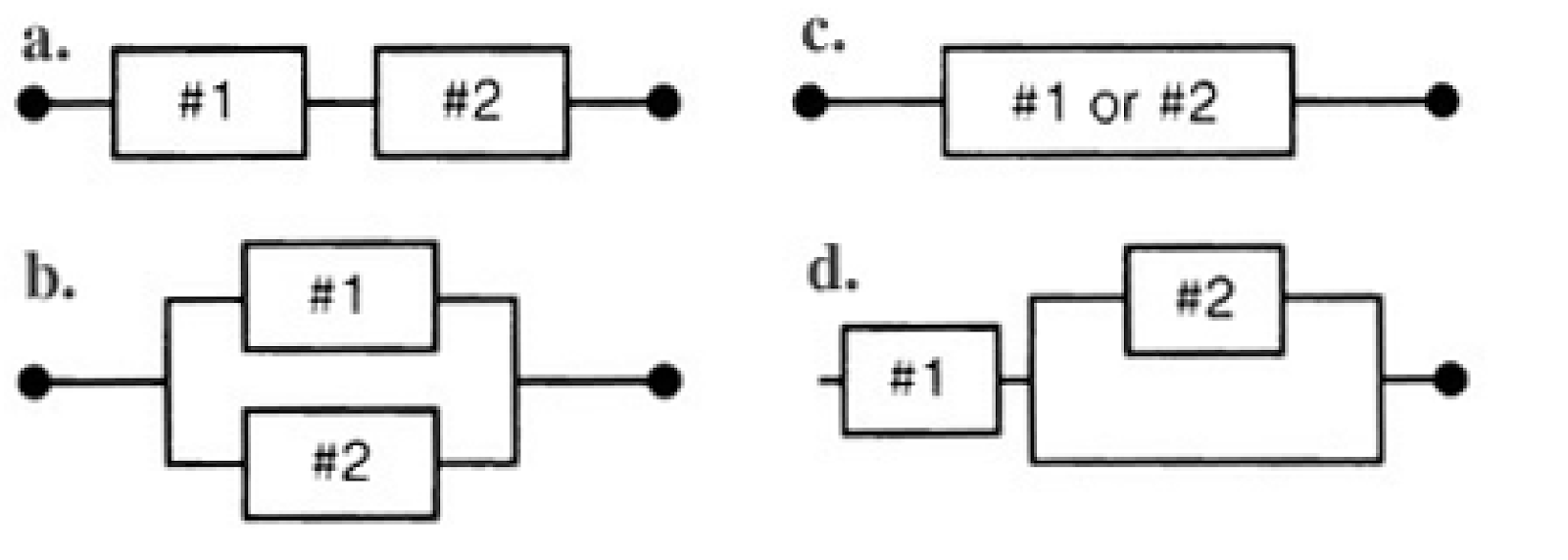
Answer A

